Or, what if we just, you know, unplug everything...?
Long before there was social media, smartphones, or AI, it seems like people more or less had this “being human” thing figured out.
Simultaneously, I’m seeing a rise in notebooks, typewriters, websites, blogs and all things anti-social-media but pro-productivity. Folks are flocking to analog ways of organizing their thoughts in the hope of feeling lighter and finding some clarity.
Is it working?
Have they cracked the code?
Over saturated, overwhelmed, over… well, all of it.
I was recently propped up in bed, facing the lamp on my nightstand and cradling East of Eden by John Steinbeck in one hand. It was late and I really should’ve gone to sleep but I couldn’t put the book down. It took a couple chapters before I found the rhythm of Steinbeck’s writing. I don’t know that I’ve read anything of his since we covered Of Mice and Men in high school. Sure, some of the language is different. Some of the social norms have aged quite repugnantly, too. In that case, yes; the differences between then and now are glaring.
BUT.
East of Eden was originally published in 1952. As I’m laying there ignoring the clock, I can feel my eyes bulging and my jaw slackening.
- Gender norms.
- Financial stress.
- Unrequited love.
- Social conditioning.
- Familial expectations.
- War and fear mongering.
-It’s all there, right there on the page.
From 1952!!
That’s a ton of the same shit we’re dealing with today. It’s all just got different clothes on. But underneath? My god—humans are humans no matter what, huh?
The hottest new trend is: unplugging.
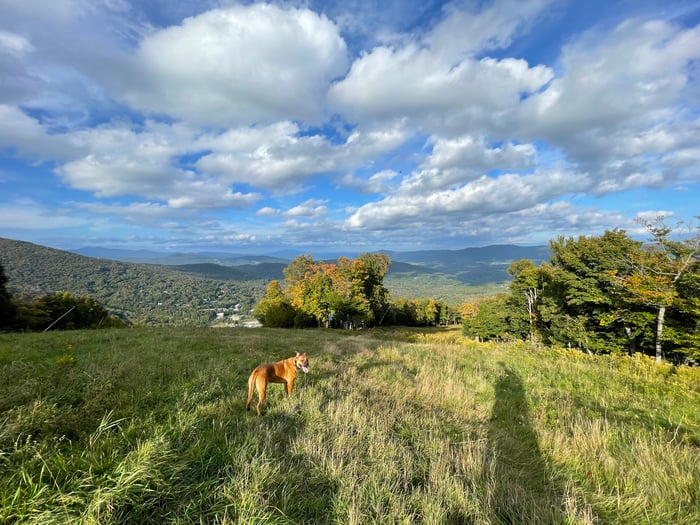
Last week, I went trail run/walking with my dog, Ava at this local ski area in Vermont. It’s actually where I grew up snowboarding.
When I first got Ava five years ago, we’d come here a lot. I was training for the Boston Marathon at the time, and going trail running with her after work helped me knock out some miles while giving her some exercise in the process. Win-win.
When we were almost to the top of the steep, gravely side-path of an otherwise grassy ski slope, though, I was huffing and puffing.
And so was she.
Still, I was just glad to be there, breathing in the silence and feeling the relief of not being needed for a bit. Ava seemed like she was enjoying it, too, and that made me happy.
What if technology isn’t actually the issue?
There’s lots of talk about how people are isolating, doomscrolling, streaming, and just generally withdrawing from social life—or from cultivating an in-person one, anyway. But, underneath all that finger-pointing, it seems to me that what we really have on our hands is an epidemic of values integration.
Whatever the reason, we’re facing an entrenched and growing misalignment between what we care about and what we have the time and space to prioritize.
- Jonathan Haidt claims it’s risk-aversion, and hypothesizes an entire generation’s been plagued by an ideology that creates passivity.
- Ify Walker offers burnout as a driving factor, and details the almost-encouraged distrust in our instincts we’ve been fostering.
- Anna Howard talks about the need to disappoint others instead of ourselves, and the journey of being yourself more by thinking about yourself less.
It’s not enough to just unplug, you have to do something with the silence that follows.
When Ava and I went running, it’d been a fair bit since we traipsed up and down that trail together. Back when she was still a puppy-puppy, those runs were sometimes full of stress for me. Training a dog to run on-leash, so they can eventually be trusted off-leash, while also training for a marathon and knowing you’ll be logging back on to finish up some client work was... well, it was a lot. Especially when running into bears with said pup-in-training was a semi-regular occurrence, too. But that was my “unplugged time.” And Ava gave me a reason to make sure it happened, otherwise I’m pretty confident I wouldn’t have gone all that consistently, despite that whole training for a marathon thing.
Cresting the top of the pitch, the breeze was rustling the already changing leaves on the trees and the setting sun cast an alpenglow-like haze across the waving grass ahead of us. We were actually standing in the same spot where, as kids, my cousins and I would use walkie-talkies to radio down to our grandmother at the bottom of the mountain and tell her to watch us while we raced each other from top to bottom.
Even then, this place was an escape.
Sometimes it feels like yelling “FIRE!” without being heard.
At multiple points throughout my life, I’ve found myself so overwhelmed that I’d fantasize about what it would be like to disappear completely. Sometimes, those thoughts were quite dark and led to medical intervention. Other times, they were rather pleasant and included palm trees, blue water, and a surfboard I had no idea how to ride (yet). Either that or a tiny villa in the Alps… I go back and forth.
Despite my best efforts, people just don’t always seem to hear the word “FIRE!” when I swear that’s what’s been coming out of my mouth. When I look and see them wearing calm and composed expressions, I know they haven’t heard me correctly. Either that, or that they’ve drastically misunderstood what I’ve said. Maybe it’s because, as a kid, I always tried to make it sound more fixable than it was. No need to be too much of a burden, right? It’s recoverable, but it just… sucks. You know? Or, maybe it’s because I never really feel the moment I’m in. That’s something I’m still working on. Actually, I’ve been working on it for what seems like my entire life at this point.
“This too shall pass” sounds like a store-brand diuretic for grief.
Seriously, I want to hate that idiom so damn much. It drives me completely nuts, even though it’s true. UGH, and I hate that it is. But it doesn’t happen like people imply when they say it. Or, at least, like how I hear it when it’s said to me. Things only pass if you take the time to do something with them; they don’t get better on their own... it’s not like time will solve your problems for you.
Problems get skipped, patched, or solved with the time and resources available to us.
It’s a hard thing to see while you’re in it.
One of my favorite ways to carve out some “me” time and spark some self-reflection is to go running and listen to a podcast. Often, I’ll end up having to finish the podcast later because I’ve slapped pause and spent the rest of the run thinking on whatever the pod stirred up for me.
Recently, a podcast I’ve been listening to for over 10 years just posted its final episode.
In a weird way, I feel like I’m losing a friend.
It seemed only fitting that I listened while going for a run to sort my life out. The episode was a two-part interview with legendary big-mountain skier, Seth Morrison, hosted by Mike Powell. While listening to the two of them talk about ski culture, I pictured my own foray through mountain-town life in my twenties.
When I was working at NOLS in Wyoming, I used to use the gym in the basement during lunch and I remember listening to The Powell Movement a lot during those sessions. When I lived and worked in Jackson Hole, I’d listen in the mornings on my way to work at the mountain. I even remember listening while driving back from Utah in a blizzard after passing my AASI Level 2 exam. And, years later, I listened to plenty more episodes while training for the Boston Marathon—in the mountains with Ava or along the lakeshore in town.
How crazy is it that so many of my memories include some guy on the other side of the country who decided to start a ski podcast in 2016?
Consumption without reflection is like drinking backwash.
I kept tuning in to The Powell Movement all these years because I enjoyed hearing some of the world’s most elite athletes talk about the obstacles they thought they were facing, and the hurdles those things turned out to be.
Mike never quite framed it that way, but that’s what I’ve always listened for. So I don’t know how to reconcile the benefit of something like that with the rest of the never-ending barrage of content we endure each day.
Because I really, really hate that.
It fucking sucks.
There doesn’t seem to be a way of avoiding the influx of oversaturated feeds and auto-play-streams that haunt daily life, though. I mean, how the hell has this become a normal and accepted part of being human?? It feels like an “all-or-nothing” binary where our only choices are to either be perpetually online or to go full monk-mode.
Sometimes, I just want a break; time to think about things and assess stuff I’ve come across, but without the negative side effects of “going dark.”
Being human requires humans, being.
I’ve always thought it’d be SO cool to be able to freeze time.
That was even the premise of an assignment I did in 5th grade. I imagined there was some hidden clubhouse my friends and I could go to at school, not unlike the Gryffindor common-room, where time would freeze when you went in and resume when you left. I don’t know why, but I’ve never forgotten that.
All these years later, it popped into my head over the weekend while driving on a rainy, chilly day here in Vermont.
Highway therapy comes in a lot of different forms for me. Sometimes a podcast gives me something to focus on other than the throes of daily life, and other times it’s overdue phone calls to close friends that help me escape and unplug for a bit. But I think the best way I know of to freeze time is by cranking the music and belting out the words right along with the band.
Which is exactly what I did while the rain tapped its way down the windshield. The soup du jour was “Wide Open Spaces” and a smattering of other songs by The Chicks.
Though I grew up in Massachusetts, I spent a lot of my youth listening to country music. I don’t know... I just find that ironic. Like, we were in New England, you know? Anyway, it’s all my dad listened to, and he and I shared car rides together every other weekend, to and from his house, for many years. There wasn’t a whole lot of conversation on those trips. One time, while I was in elementary school, I remember spending an entire hour of the drive trying to figure out a way to tell him about a classmate I had a crush on. Then I spent the last half-hour deciding not to. Mostly, country music sort of became a way for us to coexist without having to say anything, or talk about the fact that we didn’t know what to say.
So over the weekend, now in my thirties, I traveled back to 1998 for a bit, where, apparently, lyrics to some of those country songs remain burned into my brain.
When I finally got home and pulled into the driveway, I braced myself for the rain I knew I’d be stepping into. Opening the door, I got hit with the smell of the neighbor’s wood-burning fireplace. It wafted along the crisp, wet, New England breeze this way and that. Which is how I wound up standing there with my feet glued to the gravel. Because if I closed my eyes, I swear it could’ve been the early 2000s—that my mom and I were just getting out of the car at my grandparents’ place, squishing our way through the snow in the dark and following the scent of the fire. Any moment, my grandfather just might’ve yelled down “Wait! Bring up some more wood!”
But it’s 2026.
And I was walking towards the house alone after driving on the same highway my mom and I would take up from Massachusetts back then.
Nostalgia’s not enough.
Later that night, I returned to East of Eden before bed.
Propping myself up on my elbow, I found myself rereading a line of dialogue more than once. There’s plenty in the book that’s somewhat antiquated, and that requires a bit of deciphering to parse its modern meaning, but this was not that. One of the characters, Samuel, was telling his friend, Adam, to just go through the motions.
“Act out being alive, like a play. And after a while, a long while, it will be true.”
With widened eyes, I shook my head back and forth.
Sheesh.
After losing his wife, Adam was in a spell of depression (not that Steinbeck called it that, but the description fits). I reread Samuel’s words a couple more times, lowered the book, and reached my thumb and index finger to the corner of the page so I could fold it over. Granted, they didn’t have social media, smartphones, or AI between 1862 and 1918 back when the book takes place, but it seems like people more or less had this “being human” thing figured out.
Ok, sure, maybe not empirically.
But experientially?
Kind of, right?
Maybe time travel really is the answer.
Even if the wisdom is applied retroactively by Steinbeck, it's still knowledge from 1952 that remains applicable today. The biggest difference, though, is that back then “engaging” meant interacting with your life, your experiences, and the people around you more. But it kind of seems like the pace of life came with room to think baked-in.
I’m not sure we have that luxury anymore.
Room to think—to reflect—feels more like something that needs to be intentionally carved out by each and every one of us who wants some. Welcome to the world! Breathing-room not included. Sanity sold separately. Terms and conditions apply.
Who knows.
Not me.
What if we just unplug everything...?
onward.

If you enjoy reading my writing, I publish short reflections like this each day as part of my daily column, Kickturn.
Sign up to get it here.
See the latest.
Subscribe to specific columns to receive new posts directly in your inbox.